
East African Coffee Origins: From Ethiopia to Kenya, Uganda, Rwanda and Burundi

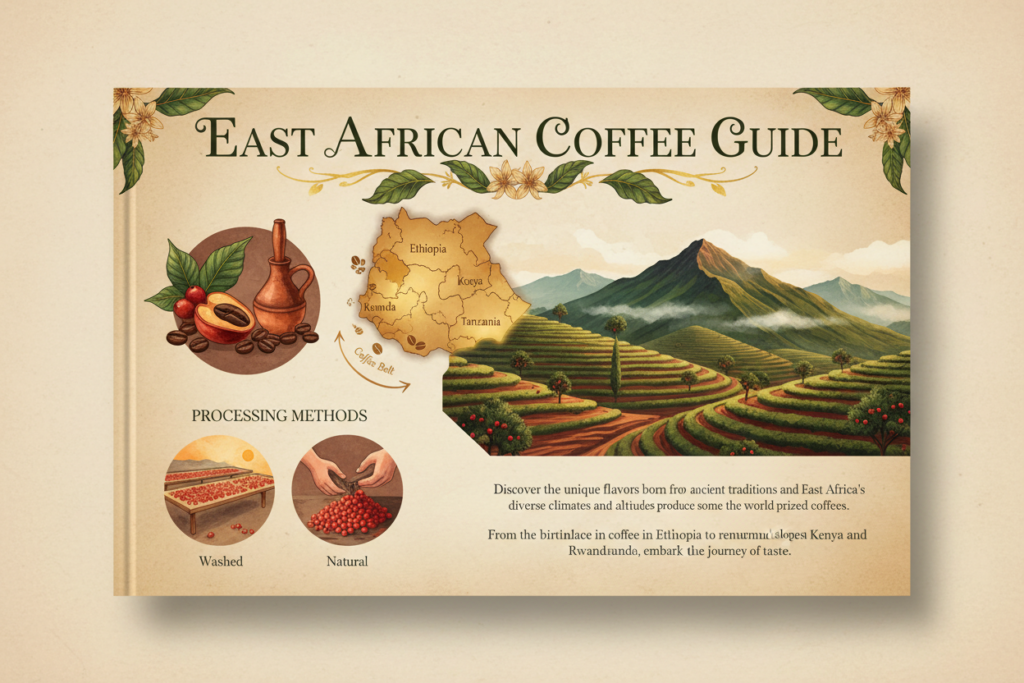
East African coffee begins in Ethiopia, the botanical home of Coffea arabica and the source of the Kaldi legend. Kenya, Uganda, Rwanda and Burundi built on this origin with volcanic soils, washed processing and bright, floral cup profiles that make each origin distinct.
- The Story of Coffee in East Africa: Kaldi and the Ethiopia–Yemen Question
- East African Coffee Countries at a Glance
- Shared Terroir: Altitude, Volcanic Soil and the Equator
- Processing and Grading: Why East African Coffee Tastes Bright
- Production and Livelihoods in East Africa
- FAQ: East African Coffee Origins
- Sources
The Story of Coffee in East Africa: Kaldi and the Ethiopia–Yemen Question
East African coffee starts with a wild plant and an old story. Coffea arabica is usually placed in the highlands of Ethiopia, which is why the coffee origin Ethiopia vs Yemen question tends to resolve in Ethiopia's favour. No ancient source records Kaldi, so the story is treated as folk history rather than documented fact.
A goatherd named Kaldi saw his goats become lively after eating red cherries, and the beans soon entered local use. Yemen's role came later. Arab traders and Red Sea ports turned coffee into a widely traded crop, which is why "arabica" echoes Arabia even though the plant is Ethiopian.
Ethiopia and Yemen both belong in the origin story: Ethiopia gave the species, Yemen gave the first large-scale commercial crop. For a long time, European buyers knew coffee mainly as a Yemeni product. For a wider guide to African coffee, see the wider guide to African coffee.
East African Coffee Countries at a Glance
East African coffee countries span five distinct origins with shared highland conditions. The table below summarises the main profiles; the cup descriptions are tendencies, not guarantees for every lot.
| Country | Growing altitude | Key varieties and lots | Main process | Cup profile |
|---|---|---|---|---|
| Ethiopia | Very high, about 1,500–2,200 m | Heirloom Arabica: Yirgacheffe, Sidamo, Harrar, Kaffa | Washed and natural | Floral, bergamot, jasmine; naturals lean blueberry |
| Kenya | High volcanic plateaus | SL-28, SL-34, AA, peaberry | Washed | Bright acidity, red and black fruits, full body |
| Uganda | High for Arabica, lower for Robusta | Robusta and Arabica; Mount Elgon | Washed and natural | Robusta: earthy, chocolatey; Arabica: sweeter and softer |
| Rwanda | High hills | Bourbon; washing stations and smallholders | Washed | Tea-like, floral, stone fruit |
| Burundi | High hills | Bourbon | Washed | Delicate, floral, red-fruit |
These are general profile notes: exact cup character varies by station, harvest and lot.
Ethiopia
Ethiopia's best-known origins are Yirgacheffe, Sidamo, Harrar and Kaffa. Washed lots are often described as tea-like and floral, with bergamot and jasmine, while naturals from the same areas lean toward blueberry and wine. Because much of the crop comes from heirloom varieties rather than a single cultivar, Ethiopian coffee carries unusually wide genetic diversity.
Ethiopian heirloom varieties are usually named by region rather than cultivar. The country remains the botanical centre of Coffea arabica, and traditional preparation is still part of daily culture. Read Ethiopian brewing methods for the full ceremony.
Kenya
Kenya's system rewards clarity. Careful washed processing, central auction lots and the famous AA and peaberry grades made Kenyan Arabica a benchmark for bright, structured cups. The SL-28 and SL-34 varieties, developed by Scott Laboratories, underpin many classic lots with strong acidity and red-fruit depth.
Smallholders and estates both deliver to the same auction system, which keeps competition focused on quality rather than volume alone. That structure has made Kenyan lots more traceable and often more expensive than many other origins.
Uganda
Uganda grows both Robusta and Arabica, with Mount Elgon as the best-known Arabica zone. Arabica versus Robusta in Africa details the differences. Robusta from lower elevations adds body for blends, while Mount Elgon Arabica gives cleaner, sweeter cups.
The Robusta base matters as much as highland Arabica for producer incomes.
Rwanda
Rwanda's coffee sector grew around smallholders delivering cherry to shared washing stations. That structure supports lot traceability and made Rwandan specialty coffee a quiet success story. The typical cup is washed, tea-like and floral, with stone fruit notes rather than heavy body.
Burundi
Burundi produces washed Bourbon, often described as delicate, floral and red-fruited. Volumes are smaller than Rwanda or Kenya, so the origin remains less visible in export markets. It is often called the forgotten origin of East African coffee, but the same volcanic and washing-station foundations apply.
The coffee economy still depends heavily on smallholders and central washing stations.
Altitude, latitude and volcanic soil shape every East African cup. Most Arabica grown in the region sits between 1,500 and 2,200 metres, where cool nights slow cherry ripening and concentrate acidity. The Great Rift Valley contributes mineral-rich volcanic soils, and the equatorial position spreads harvests across the year.
That combination is why East African flavour profiles are often described as bright, floral and high-toned. But altitude is not uniform: Uganda's Robusta grows lower, which changes body and sweetness. Cool highland conditions are one reason East African Arabica often expresses more floral acidity than lower-grown Robusta.
The result is a region where single-origin lots are often clean, bright and traceable to washing stations or cooperatives. For a shortlist of East African beans to try, start with washed lots from Kenya or Rwanda.
Processing and Grading: Why East African Coffee Tastes Bright
Washed processing dominates in Kenya, Rwanda and Burundi, and it explains much of the brightness drinkers notice. Ripe cherry is pulped, fermented, washed clean and dried on raised beds, leaving the bean's acidity and floral notes exposed. Kenya's AA and peaberry grades are screen-size and shape categories rather than quality scores, but they became shorthand for dense, high-grown beans.
The SL-28 and SL-34 varieties behind many classic Kenyan cups were developed at Scott Laboratories. Natural processing, more common in Ethiopia, dries the cherry whole and shifts the cup toward blueberry and wine. That difference is one reason a washed Yirgacheffe and a natural Harrar can taste like different origins.
Kenya's grading names have become so widely used that roasters outside East Africa treat AA and peaberry as shorthand.
Production and Livelihoods in East Africa
Coffee is a cash crop and a smallholder livelihood, not just a flavour story. The International Coffee Organization (ICO) notes in its 2026 campaign that coffee provides income for around 12.5 million farming families worldwide. World Coffee Research adds that 60% of global coffee supply comes from smallholder farmers, citing a 2022 study.
World Coffee Research also notes that five countries produce 74% of the world's coffee. World Coffee Research reported in September 2026 that about 350,000 Rwandan households depend on coffee. For the broader picture, see coffee's role in African economies.
FAQ: East African Coffee Origins
Did coffee originally come from Africa?
Yes: the wild Coffea arabica plant and the Kaldi legend point to Ethiopia's highlands.
Is coffee originally from Ethiopia or Yemen?
Botanically Ethiopia; Yemen later cultivated and traded it on a large scale.
What country in Africa is known for coffee?
Ethiopia, home to Yirgacheffe, Sidamo and Harrar, the region's best-known origins.
Why is African coffee so good?
High altitude, volcanic soils, heirloom varieties and washed processing give bright acidity, florals and red-fruit notes.
Sources
- International Coffee Organization
- World Coffee Research
Keep reading