Ethiopian vs Kenyan Coffee: Taste, Grades and How to Choose
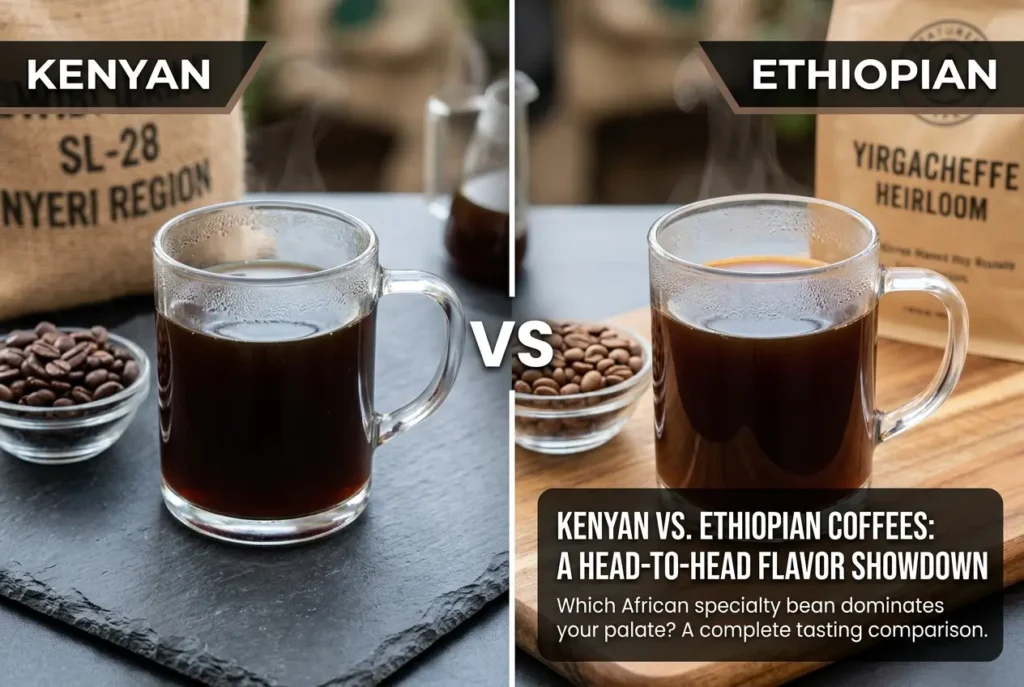
Ethiopian and Kenyan coffees are both high-grown Arabicas, but their cup styles split clearly: Ethiopian lots lean floral, tea-like and citrusy, especially when washed, while Kenyan lots are dense, juicy and berry-led with blackcurrant brightness. Neither is objectively better; the choice depends on the flavour wanted and how the bag is labelled.
According to the International Coffee Organization, coffee provides income for around 12.5 million farming families worldwide, and Ethiopia and Kenya sit on opposite ends of the East African Arabica spectrum. The table below gives a Kenyan vs Ethiopian coffee comparison at a glance.
| Factor | Ethiopian coffee | Kenyan coffee |
|---|---|---|
| Genetics | Large, genetically mixed heirloom population | Named cultivars such as SL28, SL34, Ruiru 11 and Batian |
| Cup profile | Floral, tea-like, citrus; naturals add blueberry and wine | Dense, juicy, berry-led; blackcurrant and red fruit |
| Body | Light to medium | Medium to full |
| Processing | Washed and natural both common | Almost always washed |
| Grading | Regional and station names matter | AA and other screen-size grades at auction |
| Harvest | Main crop concentrated late in the year | Main crop plus a smaller fly crop later |
| Roast | Light roasts keep florals | Light to medium roasts round out brightness |
Both are Arabica, not Robusta. The differences that matter sit in variety, processing, grading and harvest timing, which is why the label fields below are more useful than country alone.
Ethiopian coffee: floral, fruity and often tea-like
Washed Ethiopian coffees are usually described as tea-like and floral, with bergamot and jasmine notes, while naturals from the same region lean towards blueberry and wine. The cup tends to feel lighter in body and lively rather than heavy, so roasters often keep Ethiopian lots at light roast. Ethiopian coffee commonly comes from smallholders delivering cherry to shared washing stations or cooperatives, and the same district can produce strikingly different profiles depending on process and station. Buying by station or region often tells more than buying by country. For a classic washed lot at home, a slow pour-over is a good starting point; the traditional method is explained in How to Brew Ethiopian Coffee the Traditional Way.
Kenyan coffee: bright, dense and berry-led
Kenyan coffees are often described as dense, juicy and sharply focused, with blackcurrant and red fruit notes that read clearly at light roast. The acidity tends to feel wine-like and bright rather than sour, and the body is usually fuller than a washed Ethiopian cup. Most Kenyan lots are processed as washed, which pushes the fruit towards cleanliness and clarity. Roasters often use Kenyan AA lots as showcase coffees for filter brewing because the cup holds structure when hot. A well-grown lot from the central highlands can taste almost like blackcurrant cordial, with a savoury edge. This is a distinctive cup, but it is not objectively stronger or better than an Ethiopian lot.
Why varieties taste different: Ethiopia’s heirloom pool vs Kenya’s named cultivars
Variety explains a large part of the split. According to the World Coffee Research catalog, Arabica coffee began in Ethiopia, and most historic cultivars descend from Typica and Bourbon. Ethiopian heirloom coffee is not a single variety; it is a broad, genetically mixed population selected over generations on small farms across regional districts. Kenya took a different route: researchers at what became Scott Agricultural Laboratories selected and released a small set of named cultivars, and the World Coffee Research catalog profiles several of them, including SL28, SL34 and Ruiru 11, with Batian added more recently. In the cup, Ethiopian heirloom mixes tend to give floral, layered complexity that varies by district, while Kenya’s narrow group of cultivars delivers a more consistent blackcurrant and red-berry signature. The difference matters when reading a bag: “heirloom” signals a genetically varied lot, while a named Kenyan cultivar signals a deliberately fixed genetic line.
- Ethiopian heirloom: many local selections, high genetic diversity, tea-like and floral layers.
- SL28 and SL34: older Kenyan cultivars prized for red-berry flavour and drought tolerance.
- Ruiru 11 and Batian: newer Kenyan cultivars bred for disease resistance and cup quality.
See Arabica varieties and their cup character.
Washed vs natural processing
Processing explains the other half of the difference. In a washed process, the cherry pulp is removed before drying, so the seed ferments cleanly and the cup shows crisp, bright acidity. In a natural process, the whole cherry dries around the seed, which adds fruit, wine and heavier sweetness. Kenya is almost exclusively washed, which is why Kenyan lots tend to read cleaner and more acidic. Ethiopia uses both methods at scale, so a washed Yirgacheffe and a natural Guji can taste like different origins. Both are still Arabica, not Robusta; for a fuller breakdown see Arabica vs Robusta from an African perspective.
Grades and auctions: what AA really means
Kenyan AA grade is a screen-size designation: beans graded AA pass through screen size 17/18, the largest common grade, and that size commands a premium at auction. It does not guarantee a particular flavour, but larger high-grown beans are often associated with the dense, juicy cup Kenya is known for. Kenya’s auction system, built around the Nairobi Coffee Exchange, holds weekly sales that separate lots carefully and reward traceable outturns; Ethiopia routes much of its export coffee through the ECX, although direct station sales have grown. A bag that lists a grade alongside a station and a date provides more than the grade alone. Read AA as a starting filter, not a verdict: the same grade can hide meaningful differences in altitude, harvest timing and processing care. Buyers should check the other label fields before paying a premium for AA.
Harvest seasons and availability
Harvest calendars from the International Coffee Organization place Ethiopia’s main crop between October and January. Kenya’s main crop runs from October to December, with a smaller fly crop from April to June. This means fresh Ethiopian and Kenyan arrivals often overlap at roasteries in the final quarter, while Kenyan fly crop lots can appear months later. Ethiopian arrivals tend to bunch into a shorter period, so seasonal menus change more abruptly. Checking a harvest date on the bag is more useful than comparing origins in the abstract, because the same origin can behave differently at six months versus twelve months post-harvest. Freshness is not a flavour; it is a condition of the cup.
Does altitude make a difference?
Altitude shapes both origins more than country alone. Both countries grow much of their specialty Arabica between 1,500 and 2,000 metres above sea level, which slows cherry development and tends to concentrate acidity and complexity. Many of the most celebrated lots from both countries come from mountain districts rather than lowland estates. A high-altitude station name is often a better predictor of brightness than the country label. Altitude works with variety and process, so it is one signal among several, not a guarantee. For a tour of how those regions differ, see African coffee regions, from Ethiopia to Uganda.
Brewing and roast: how to match the cup
Light roast and pour-over work well for both origins: they preserve florals in Ethiopian washed lots and keep Kenyan blackcurrant notes sharp. Start with a 1:16 coffee-to-water ratio and a 30-second bloom, then adjust by taste; finer grinds and hotter water extract more sweetness. For more body, a French press or a medium roast softens the edge without burying the fruit. Dark roast rarely helps these coffees; it tends to replace origin character with roast character.
- Washed Ethiopian: pour-over, 1:16 ratio, off-boil water.
- Natural Ethiopian: French press or cupping bowl to show fruit.
- Kenyan AA: pour-over or filter; medium roast if the brightness feels sharp.
How to read a bag label: region, grade, process and station
Specialty bags from these origins usually list four fields worth checking. The region or station tells where the lot grew; the variety or “heirloom” tells roughly which genetics to expect; the process tells washed or natural; and a grade such as AA tells the size class used at auction. A fifth detail, harvest date, tells how fresh the lot is. Start with the station and process, because those often predict cup style more reliably than a country name. If the bag only says “Ethiopian” or “Kenyan” and gives no station, process or date, it is a generic lot.
- Region or station: predicts local cup tendencies.
- Variety: heirloom for floral, named Kenyan cultivar for red fruit.
- Process: washed for clean, natural for fruit.
- Grade: AA filters for large beans, not flavour.
- Harvest date: freshness context.
For current examples, see African coffee beans worth trying in 2025.
The short version: how to choose
Ethiopian coffee suits drinkers who want florals, citrus and tea-like elegance, especially from a washed lot. Kenyan coffee suits drinkers who want a dense, juicy blackcurrant punch and a fuller body. Neither is the better origin; they sit on opposite sides of East African Arabica. Let the process, variety and roast on the bag guide more than the flag. A light-roast washed Ethiopian and a light-roast Kenyan AA are two different tools for different mornings.
FAQ
Is Ethiopian coffee high quality?
Ethiopian coffee is Arabica, often high-grown and built on heirloom varieties, and it can be excellent when the lot, grade and freshness are good. Quality varies by station, process and harvest, so the label matters.
Which country in Africa has the best coffee?
There is no single answer. Ethiopia and Kenya dominate the East African specialty conversation, but with opposite profiles: Ethiopia runs floral and tea-like, Kenya runs bright and berry-led.
Is Kenyan coffee stronger than Ethiopian coffee?
No. Perceived strength depends on roast level and brewing ratio, not origin. A dark-roasted Ethiopian will taste stronger than a light-roasted Kenyan, and vice versa.
Is Kenyan coffee more acidic than Ethiopian coffee?
Kenyans are often perceived as more brightly acidic and juicy, while washed Ethiopians are more citrusy and floral. The process matters as much as origin: a natural Ethiopian can feel softer and fruitier than a washed Kenyan.
What should I look for on a Kenyan or Ethiopian coffee bag?
Region or station, variety, process, grade or screen size (AA in Kenya), and harvest date. Start with the process and station; they usually predict cup style better than country.
Sources
World Coffee Research — Varieties Catalog
International Coffee Organization