
Kenyan Coffee Guide: Regions, Grades and Flavour

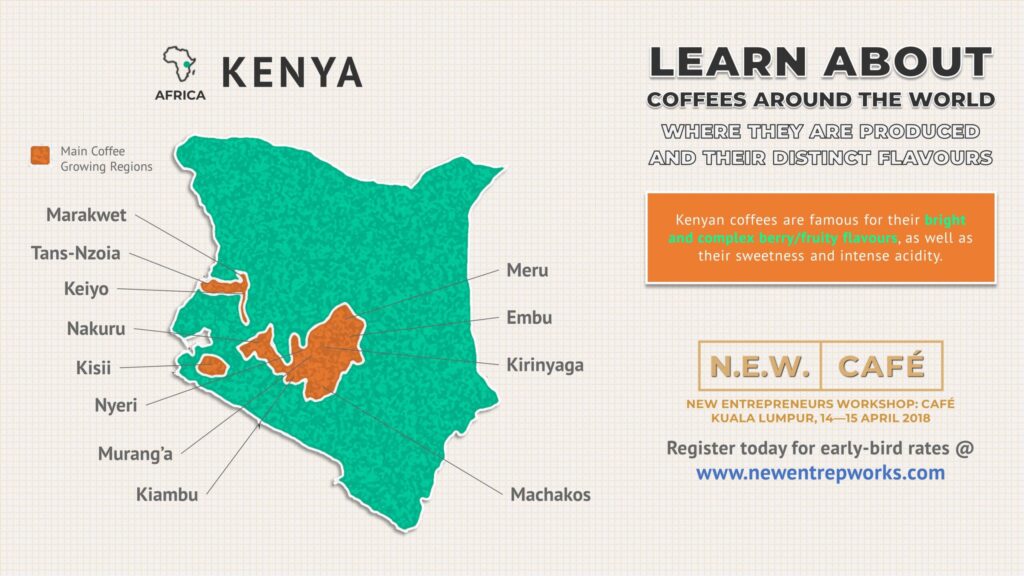
Kenya is a small producer with a large reputation. The USDA's Foreign Agricultural Service estimates the 2025/26 crop at 850,000 60-kilogram bags and forecasts 950,000 for 2026/27, from about 106,000 harvested hectares, according to Daily Coffee News' summary of the report. The Nairobi Coffee Exchange describes the cup as clear, bright and often wine-like, with vibrant acidity and fruity notes. This guide explains where it grows, how it is graded, which varieties shape it, and how a lot gets from a smallholder to a roaster.
Where Kenyan coffee grows
The Nairobi Coffee Exchange says coffee is grown mainly in the central highlands and the Rift Valley, in counties including Nyeri, Kirinyaga, Murang'a, Kiambu, Embu and Meru, plus parts of the western and Rift regions. Embu and Meru lie on the eastern side of Mount Kenya, Nyeri and Kirinyaga on its southern and western slopes. The country's coffee belongs to many small farms: the New Kenya Planters Cooperative Union counts about 4,000 estates, 550 cooperatives and 800,000 smallholder farmers, as reported by the Specialty Coffee Association. Smallholders deliver cherry or parchment through cooperatives to licensed mills, where the coffee is processed and graded before sale at the exchange.
The same USDA report says farms in the key Mount Kenya region flowered strongly after a drought that lasted into March 2026. It also notes that conversion of coffee farms to housing around Nairobi, Thika, Kiambu and Nyeri has slowed over the past two years, though analysts quoted in it say that could reverse if prices fall. For a wider view of the flavours East Africa's altitude and soils give, see why African coffee is so distinct.
Varieties: SL28, SL34, Ruiru 11 and Batian
Four varieties come up on Kenyan labels. World Coffee Research's catalogue lists what each one offers a farmer:
| Variety | Yield potential | Bean size | Disease | Cup quality |
|---|---|---|---|---|
| SL28 | Low | Large | Drought tolerant; susceptible to major diseases | Very good potential; exceptional at high altitude |
| SL34 | Medium | Large | Highly susceptible to coffee berry disease | Exceptional at high altitude |
| Ruiru 11 | Very high | Large | Resistant to coffee berry disease; tolerant to leaf rust | Good at high altitude |
| Batian | High | Very large | Resistant to coffee berry disease; tolerant to leaf rust | Very good at high altitude |
The trade-off is clear in the table. SL28 and SL34 carry the cup reputation but yield less and fall ill more easily; Ruiru 11 and Batian give up some of that cup potential for resistance and yield. Ruiru 11 is a dwarf, compact hybrid, and Batian is tall. A bag that names its variety tells you something about the farm's risks as well as the flavour.
How Kenyan coffee is graded
Kenya grades green coffee by bean size and weight, defects and cup quality. The Nairobi Coffee Exchange's grade guide sets out the main grades:
| Grade | What it is |
|---|---|
| AA | Screen 18, the largest standard size |
| AB | Screens 16 and 17, a mix of sizes widely used in blends |
| PB | Peaberry: round beans from cherries where only one seed developed |
| C | Smaller beans, used in blends and for local markets |
| E | "Elephant": very large beans, less common |
| TT | Light-density beans that float in grading, separated from the main grades |
| T | Small or light beans |
| MH / ML | Mbuni: dry-processed (unwashed) coffee |
The grade describes size and density, not the tree: a bean can be AA and still taste less interesting than a well-processed AB, because the exchange also weighs cup quality. The Exchange states that cup quality "can influence value beyond size alone".
Flavour, in practice
The exchange's own wording for Kenyan coffee as a whole is "clarity, brightness, and complex flavour profiles", and it lists Mbuni (dry-processed) as the separate, unwashed category in its grading. Specific notes such as blackcurrant on a bag come from roasters, not from the grading system, so treat them as the roaster's description of one lot rather than a rule for a region.
From mill to auction
Kenya's sector is changing. A new Coffee Act, enacted in March 2026, moves regulatory and commercial oversight from the Agriculture and Food Authority to a re-established Coffee Board of Kenya. It also creates a Coffee Research and Training Institute separate from KALRO, and codifies reforms since 2022 that include changes to the Nairobi Coffee Exchange and a digital direct-settlement system meant to pay farmers faster. The exchange itself is where licensed buyers bid for lots; it describes the auction as giving transparent price discovery.
Reading a Kenyan label
Look for four things, in this order:
- The grade (AA, AB, PB): it tells you size, not flavour.
- The county or the cooperative and mill: Nyeri, Kirinyaga, Embu and Meru are named by the exchange as producing counties.
- The variety: SL28 and SL34 for cup potential, Ruiru 11 and Batian for resistance.
- The process: Mbuni means dry-processed; for other lots, ask the roaster which process was used.
A bag that says only "Kenya AA" is still a useful start. The county, mill and variety are what separate one AA lot from another.
Keep reading