
African Coffee Varieties: SL28, Bourbon and Ethiopian Heirlooms

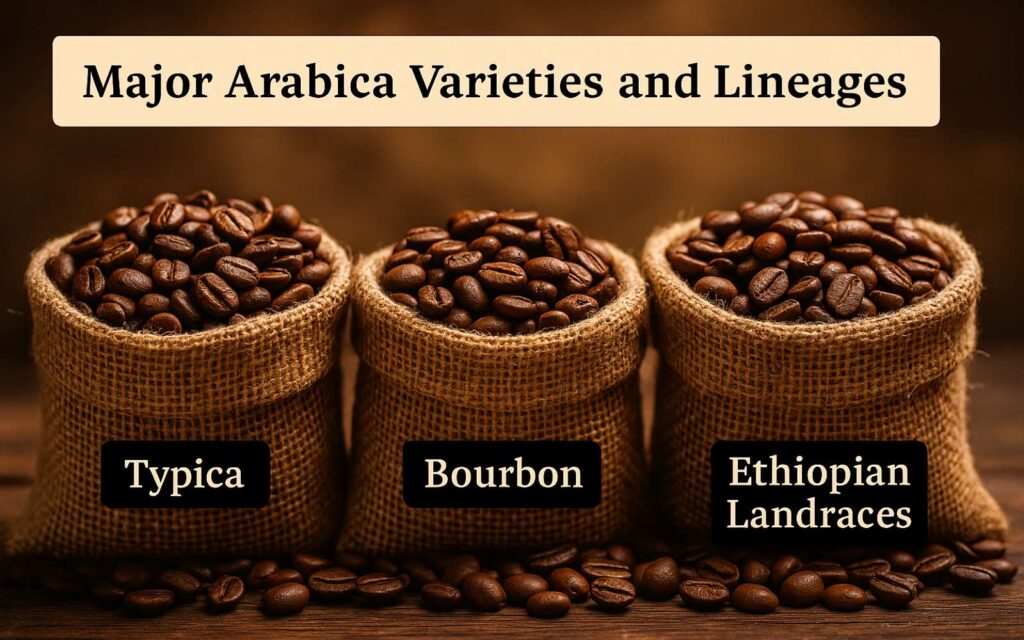
African coffee varieties are the named cultivated plants behind regional labels. The main ones are Ethiopia's heirloom landraces, Kenya's SL28 and SL34, and Bourbon-types grown in Rwanda and Burundi. Their taste comes from genetics plus altitude, soil and processing; regional names like Yirgacheffe are not varieties.
- What counts as an African coffee variety?
- Ethiopia’s heirloom varieties: landraces, not one coffee
- Kenya’s SL28, SL34, Ruiru 11 and Batian
- Bourbon, Typica and Geisha in the Great Lakes
- African coffee varieties at a glance
- Why do African varieties taste distinct?
- How to choose an African variety for brewing
- FAQ
What counts as an African coffee variety?
A coffee variety is a cultivated plant selected for stable traits such as yield, disease resistance and cup quality. A region label describes where the coffee was grown. According to World Coffee Research, Arabica began spreading from Ethiopia in the mid-1700s, and most cultivated coffees descend from Typica and Bourbon. A landrace is a local population shaped by farmers over generations; a hybrid is a deliberate cross. "Heirloom" is not a single type. It is a working term for Ethiopia's many local selections, many of which trace back to research at the Jimma Agricultural Research Centre (JARC). Regional names such as Yirgacheffe, Sidamo and Harrar identify coffee-growing regions, not varieties. Labels often blur the two categories, so reading them carefully is worth the effort.
Ethiopia’s heirloom varieties: landraces, not one coffee
Ethiopian heirloom coffee varieties are local landraces selected by farmers, not one named variety. Arabica coffee has its native home in Ethiopia, which is why Ethiopian heirloom coffee varieties are so genetically diverse. The Jimma Agricultural Research Centre began cataloguing selections in the 1970s, working from collections gathered in Ethiopia's coffee forests. Yirgacheffe, Sidamo and Harrar are geographic names, not botanical varieties: a washed Yirgacheffe is often described as tea-like and floral, with jasmine and bergamot; naturals from the same area lean towards blueberry and wine. Because landraces are rarely uniform, roasters usually label Ethiopian lots by washing station and region rather than by variety. Two bags from neighbouring villages can therefore taste quite differently. That genetic range is part of what makes Ethiopian heirloom coffee varieties so useful to breeders and so varied for drinkers. To learn how to brew Ethiopian heirloom coffees, see our brewing guide.
Kenya’s SL28, SL34, Ruiru 11 and Batian
Kenya's best-known Arabica varieties are SL28 and SL34. World Coffee Research describes SL28 as drought-tolerant and SL34 as adapted to high-rainfall areas. In the cup, SL28 and SL34 are often described as bright, with blackcurrant, savoury or tomato hints, and a full body. Ruiru 11 and Batian are more recent hybrids bred for resistance to coffee leaf rust and berry disease, so they usually cost less to manage. Kenya AA is not a variety; it is a screen-size grade based on bean size. While SL28 and SL34 shape Kenya's classic profile, many smallholders now grow Ruiru 11 or Batian alongside them. SL28 is prized for its complexity, while SL34 is often more productive in wetter zones. Most Kenyan coffee is washed, which makes the acidity cleaner and the blackcurrant note more precise. The flavours are not absolutes: a SL28 from a lower-altitude farm will taste softer and less bright than one from the central highlands.
Bourbon, Typica and Geisha in the Great Lakes
Bourbon is the dominant Arabica variety in Rwanda and Burundi, introduced through early colonial-era plantings. In Rwanda, Bourbon is grown mainly by smallholders who deliver cherry to shared washing stations, often through cooperatives; this structure explains the clean, sweet cup profile often described as caramel, orange and black tea. Bourbon's sweet profile depends on clean processing; a poor ferment can hide it. Typica and Geisha are less common in the Great Lakes, but they appear in some speciality lots and research plots. Typica tends towards softer acidity and chocolate, while Geisha can carry intense florals and stone fruit. Geisha originated in Ethiopia and later became famous through Panama, yet in Africa it remains a niche planting. Rwanda's washing stations typically process Bourbon as fully washed, which keeps the cup transparent. For a closer look at Rwandan Bourbon, read our profile of Rwanda's specialty coffee.
African coffee varieties at a glance
The table below groups five varieties covered in this guide by country, altitude, process and typical cup profile.
| Variety | Main countries | Altitude | Typical process | Cup profile |
|---|---|---|---|---|
| Ethiopian heirloom | Ethiopia | High (varies by region) | Washed or natural | Floral, tea-like, stone fruit; naturals can lean blueberry |
| SL28, SL34 | Kenya | High | Washed | Bright, blackcurrant, savoury, full |
| Bourbon | Rwanda, Burundi | High | Washed | Sweet, caramel, orange, black tea |
| Typica | Rwanda, Burundi (limited) | High | Washed | Softer acidity, chocolate |
| Geisha | Ethiopia (origin), Rwanda (limited) | High | Washed | Intense floral, stone fruit |
These profiles describe tendencies, not fixed rules; processing and terroir move them. Use it as a starting point, because altitude and process can shift a cup as much as variety does.
Why do African varieties taste distinct?
Flavour is not genetic alone. Altitude, soil, harvest timing, and processing all shape a variety's cup. According to the International Coffee Organization, coffee supports around 12.5 million farming families worldwide, many in Africa and Latin America. That smallholder structure often means mixed varieties and careful hand-sorting, which adds to the complexity. Processing matters just as much as genetics: a natural Ethiopian heirloom and a washed one can taste like different coffees. Our guide to why African coffees taste distinct covers the broader picture. For a botanical guide, the key is simple: a SL28 grown at low altitude will not taste like the same variety grown high in Kenya's central highlands.
How to choose an African variety for brewing
For a first filter brew, Ethiopian heirloom coffees reward a clean paper filter and a medium-fine grind, especially with a longer bloom. For a richer cup, Kenyan SL28 or SL34 suits a coarser grind and slightly cooler water to soften their high acidity. Bourbon from Rwanda tends to be more forgiving across methods, making it a good starting point for espresso or milk drinks. If you use a V60, aim for a slower pour to bring out fruit notes; for French press, a coarser grind keeps the cup sweet rather than syrupy. Start with a 1:16 water-to-coffee ratio by weight, then adjust to taste. A burr grinder helps unlock the clearer fruit notes in African varieties. Our guide to African brewing methods includes step-by-step recipes.
FAQ
What are the main varieties of coffee?
Arabica varieties include Ethiopian heirlooms, Bourbon, Typica, Geisha, SL28 and SL34; Robusta is the main canephora type.
Which country in Africa has the best coffee?
There is no single answer: Ethiopia is known for floral heirloom range, Kenya for bright SL28/SL34 acidity, and Rwanda for sweet Bourbon.
What is Kenyan coffee like?
Kenyan coffee is often described as bright and full-bodied, with blackcurrant, savoury or tomato hints in SL28 and SL34.
What is the difference between a variety and a region?
A variety is genetic; a region is geographic, but region shapes processing and cup character.
Keep reading