
Arabica Climate Change Breeding: Challenges & Solutions

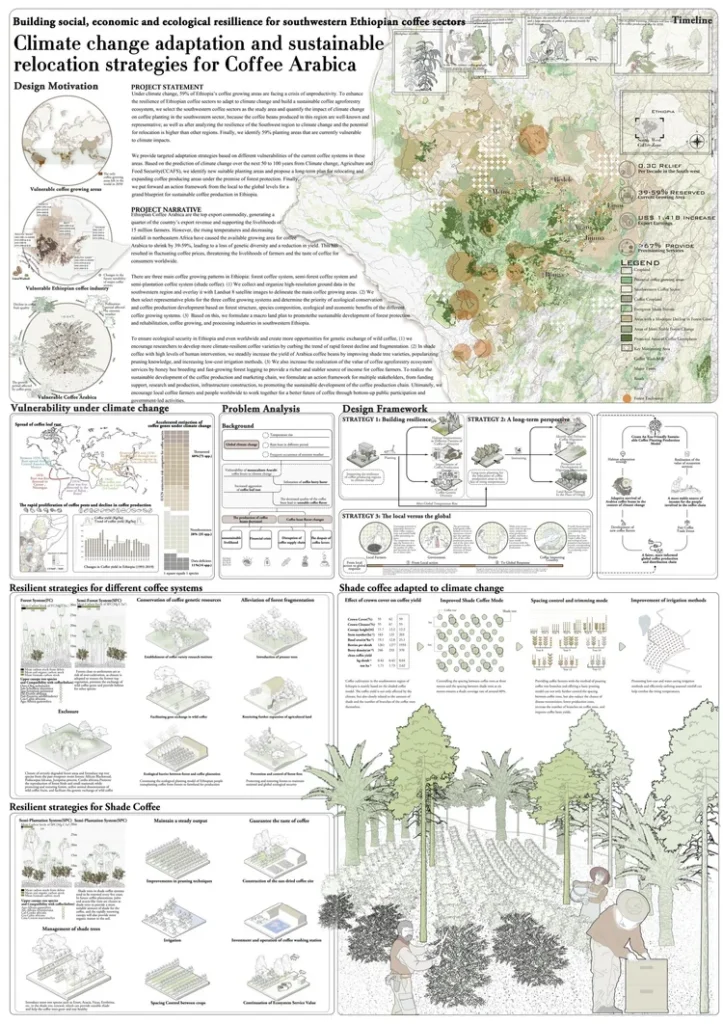
Climate change is shrinking the land where Arabica grows well, so breeders are using wild relatives and F1 hybrids to combine heat tolerance, rust resistance and cup quality. Here is why Arabica is vulnerable, which traits breeders prioritise, and how East African programmes test them.
Coffee supports around 12.5 million farming families worldwide, according to the International Coffee Organization, and Arabica is the species most exposed to shifts in climate.
Why climate change hits Arabica hardest
Arabica is a cool-climate, highland species, and that makes it unusually sensitive to a warming world. Its preferred conditions are narrow, which is why a small temperature rise matters more for Arabica than for Robusta. For a fuller background on the species, see Arabica in detail. Modelling by de Freitas et al. (2024) suggests suitable Arabica land could shrink by about 50% by 2050. The pressure is already visible in Nicaragua, where the suitable growing belt has moved from around 1,200 metres to 1,600 metres.
Three pressures stand out:
- Higher temperatures and water stress push Arabica further uphill, reducing the land available to smallholders. Arabica prefers stable, cool conditions, so even a few degrees of warming can depress flowering and bean quality.
- Warmer, wetter spells help coffee leaf rust (Hemileia vastatrix) spread. The 2012–13 outbreak in Central America showed how quickly a disease can move through genetically similar trees.
- More erratic rainfall makes flowering and cherry development harder to predict, which complicates harvesting and replanting decisions.
Each pressure hits the same plant from a different angle, and together they explain why breeders treat climate resilience as a bundle of traits rather than a single fix. These losses also deepen the sustainability pressures on African coffee.
The narrow genetic base of Arabica
The species' history explains the problem. Most cultivated Arabica comes from the Typica and Bourbon groups, which trace back to a small number of trees taken from Ethiopia centuries ago. Because those groups are closely related, a single pest or disease can spread across whole regions.
Cultivated Arabica descends from a small number of wild plants in the Ethiopian highlands. It is tetraploid, carrying four sets of chromosomes, and it normally pollinates itself. Those two facts explain both its quality and its fragility: self-pollination keeps desirable cup profiles stable, but it also means most cultivated trees share the same weaknesses.
| Feature | Cultivated Arabica | Consequence |
|---|---|---|
| Origin | A handful of wild Ethiopian plants | Low genetic diversity across farms |
| Chromosomes | Tetraploid (four sets) | Complex breeding, but potential for hybrid vigour |
| Reproduction | Self-pollinating | Uniform fields share the same disease risks |
| Climate niche | Cool highlands | Vulnerable to warming and dry spells |
Wild Arabica populations in south-west Ethiopia still hold the genetic variation that cultivated fields lack. Robusta (Coffea canephora) is more genetically diverse and more heat tolerant, which is why breeders sometimes look to wild relatives or species crosses for new traits. For a direct comparison, see Arabica versus Robusta. Arabica also belongs to a much wider coffee species family.
Breeding for a hotter, drier future
Traditional selection vs F1 hybrids
Traditional pedigree selection works by crossing two promising parents and then selecting the best offspring over many generations. It is reliable but slow: a new variety can take 20–25 years from cross to release.
F1 hybrids are first-generation crosses between genetically distinct Arabica parents. Because the parents are chosen for complementary traits, the offspring can show hybrid vigour, or heterosis. World Coffee Research reports that F1 hybrids can deliver 20–40% higher yields and improved rust resistance.
Producing F1 seed at scale is harder than it sounds. Arabica flowers need controlled pollination, and many F1 hybrids are propagated as clones or through seed gardens, which adds cost and time for nurseries.
| Approach | Time to release | Traits delivered | Yield potential |
|---|---|---|---|
| Pedigree selection | 20–25 years | Rust resistance, cup quality, local adaptation | Baseline |
| F1 hybrids | Shortens some steps, but still part of a long pipeline | Heat tolerance, rust resistance, cup quality | +20–40% |
Traits and timelines
The traits themselves are not interchangeable. Heat tolerance may come from one parent, rust resistance from another, and cup quality from both. F1 hybrids let breeders combine these more quickly than repeated backcrossing, which is why they matter for climate adaptation.
Cup quality remains the gate. A climate-resilient tree that produces flat or bitter coffee will not help farmers, because buyers pay for flavour, so every release is screened by cuppers.
Breeders usually move through four stages:
- Collect: gather wild and cultivated Arabica material from Ethiopia and other centres of diversity.
- Cross: cross selected parents to create new combinations of traits.
- Evaluate: test offspring in multi-location trials for yield, disease resistance and cup quality. Trials also record how varieties perform under local rainfall, because a hybrid that excels in one country may struggle in another.
- Release: distribute the best material as seed or clones to nurseries and farmers.
Marker-assisted and genomic selection are now used to identify useful genes earlier, which can shorten evaluation without skipping field trials. In practice, World Coffee Research's International Multilocation Variety Trial has tested 32 varieties across 17 countries over ten years, producing the yield and rust performance data that breeders use to decide what to release. The trial's data is shared with national programmes, so East African researchers can pick varieties without repeating years of local testing.
What East African breeding programmes are doing
East Africa is central to Arabica's future: Ethiopia holds the wild gene pool, while Kenya, Uganda, Tanzania and Rwanda run active improvement programmes. For the geography behind these efforts, see East African growing regions. The work is practical as well as scientific: national institutes test varieties under local rainfall and disease pressure before releasing seed to farmers.
Smallholders grow most of the region's coffee, so improved seed has to reach thousands of scattered farms, not just research stations.
- Ethiopia: national and regional institutes conserve wild Arabica populations and screen local landraces for drought and rust tolerance. Its forests act as a living library for future breeding.
- Kenya: the Coffee Research Institute works on rust-resistant varieties suited to mid-altitude zones.
- Uganda: better known for Robusta, but highland Arabica is expanding; World Coffee Research and partners are strengthening seed systems for smallholders.
- Tanzania: participates in Innovea, testing high-altitude Arabica selections.
- Rwanda: moving a new wave of climate-resilient varieties into advanced trials; World Coffee Research notes this matters for the 350,000 households that depend on coffee for livelihoods.
The Innovea network, led by World Coffee Research, now spans 11 countries and includes Kenya, Uganda and Tanzania among its partners. World Coffee Research reports that TIME named Innovea one of its Best Inventions for 2025.
These programmes focus on rust resistance first, because the disease can destroy a farm's income in one season. Seed delivery is the second bottleneck: a good variety only helps if farmers can buy healthy seedlings nearby.
Five terms worth knowing
These five terms appear throughout breeding discussions, and they help when reading trial results or variety catalogues.
- Heterosis: hybrid vigour, when first-generation crosses outperform both parents. It is the genetic mechanism behind many F1 yield gains.
- F1 hybrid: the first-generation offspring of a cross between two distinct Arabica parents.
- Genomic selection: using DNA markers to predict which seedlings are worth field testing, rather than waiting years for full growth. This helps breeders discard weak seedlings early.
- Coffee leaf rust: a fungal disease caused by Hemileia vastatrix that attacks leaves and reduces yield.
- Genetic base: the total genetic diversity available within a cultivated or wild population; a narrow base means fewer options for adaptation.
A wider base gives breeders more raw material, so conserving Ethiopia's wild coffee forests is part of the same story.
FAQ
Why is Arabica more vulnerable to climate change than Robusta? Arabica is a cool-climate, self-pollinating species with a narrow genetic base and lower heat tolerance; Robusta grows better in warmer, drier conditions.
Can breeding really save Arabica? Yes: F1 hybrids and genomic selection are already producing trees with better heat tolerance, rust resistance and cup quality, though releases take 20+ years.
How long does it take to breed a new coffee variety? Traditional pedigree selection usually takes 20–25 years from cross to release; marker-assisted and F1 methods shorten some steps.
What is the narrow genetic base of Arabica? Cultivated Arabica descends from a small number of wild Ethiopian plants, so most plants are genetically similar and share weaknesses.
Who is breeding climate-resilient Arabica? World Coffee Research through its Innovea network, plus national coffee institutes in Kenya, Uganda, Tanzania and Ethiopia.
Sources
- World Coffee Research — breeding data and Innovea network.
- International Coffee Organization — global production context.
- de Freitas et al. (2024), PLOS — Arabica climate suitability modelling.
- Bertrand et al. (2021, 2025) — breeding rationale.
Keep reading