
Taste of Harvest Competition: How African Coffee Lots Are Scored

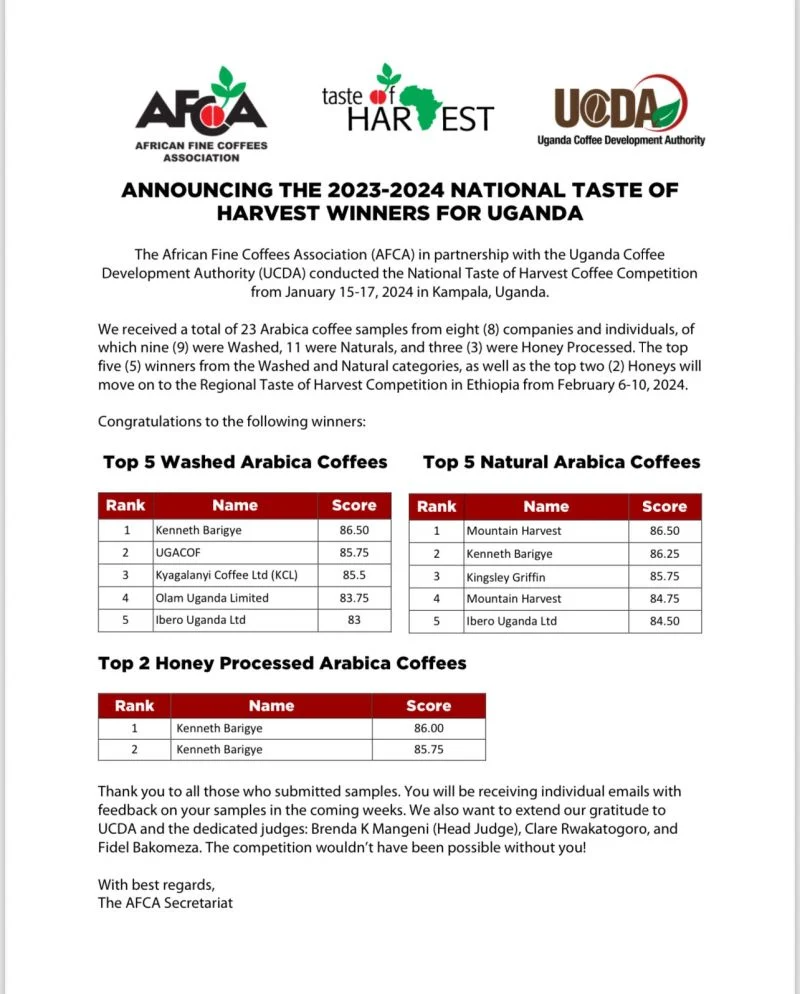
Taste of Harvest is the African Fine Coffees Association competition that cups and ranks African coffee lots by quality. Each lot is scored on a 100-point scale; the highest-scoring lots are auctioned. Winning lots tend to combine clean cup profiles with traceable producer origins. The guide that follows explains the cupping process, the numbers behind winning lots, and how results feed into auctions for traceable East African coffees.
- What is the Taste of Harvest competition?
- How does the Taste of Harvest cupping competition work?
- What separates a winning Taste of Harvest lot?
- Taste of Harvest results and auction prices by the numbers
- How to participate and follow Taste of Harvest
- Why Taste of Harvest rewards traceability
- FAQ
- Sources
What is the Taste of Harvest competition?
The Africa Taste of Harvest competition is a fine-coffee quality contest organised by the African Fine Coffees Association (AFCA). AFCA has described a relaunched Taste of Harvest as a regional event, positioning the competition as a showcase for high-scoring coffees from across the continent.
Producers enter coffee lots from specific estates, cooperatives, or washing stations. Entries are cupped blind and ranked by cup score, with results separated by processing method. The competition sits alongside AFCA’s broader coffee events, but its core output is a set of verified scores that buyers and producers can use when an auction follows. A lot that scores well in a Taste of Harvest edition carries that number into subsequent marketing and auction catalogues, where it functions as an independent quality signal rather than a producer’s own claim.
How does the Taste of Harvest cupping competition work?
Every lot in the Taste of Harvest competition is evaluated through blind cupping. Cuppers assess fragrance, aroma, flavour, acidity, body, and aftertaste without seeing the producer name. The final coffee cupping score determines whether a lot advances to auction and at what level of interest.
Washed and natural entries
Entries are split by processing method. Washed coffees are pulped and fermented before drying, often known for floral acidity and clarity. Natural coffees dry inside the whole cherry, tending towards darker fruit, wine-like notes, and heavier body. In a published AFCA results list, Tadesse Yonka placed third in the Naturals category.
The 100-point cup score
Cuppers use the 100-point coffee cupping score system associated with Specialty Coffee Association standards. Coffees scoring 84 or above are generally considered specialty quality. A score of 86.50, such as the one recorded for a high-placing Natural entry, indicates a high-end lot with strong sweetness, balance, and intensity.
What cuppers describe
Cupping notes for top African lots often mention floral aromatics, stone fruit, citrus acidity, and a clean cup. Washed Ethiopian and Kenyan cup profiles are often described as tea-like or bergamot-forward, while naturals lean towards blueberry and wine. The scoring system rewards clarity and structure more than heaviness.
Cuppers also distinguish between descriptors that signal origin character and those that signal processing quality. A floral note in a washed Kenyan coffee usually reads as a varietal signature, while a clean finish in a natural Ethiopian lot reflects careful drying and sorting. Judges weigh both: a lot can score highly only when its processing does not obscure its origin.
What separates a winning Taste of Harvest lot?
Winning lots tend to stand out on two fronts: a cupping score near the top of their category and a documented route back to a single washing station or producer group. The table below shows examples that appear in published AFCA competition lists.
| Producer or cooperative | What published lists show | Score |
|---|---|---|
| Kenneth Barigye, Mountain Harvest | Named among Taste of Harvest winners | — |
| Ankole Coffee Producers Cooperative Union Ltd. | Named among Taste of Harvest winners | — |
| Tadesse Yonka | Third in Naturals category | 86.50 |
Beyond the score, winners often come from cooperatives that can identify the lot by washing station and harvest date. That traceability matters because auction buyers cannot taste every cherry; they rely on documented processing and a verifiable smallholder link. The same characteristics also help explain what makes African coffee distinct in wider markets.
A winning lot is rarely an accident of one good harvest. Cooperatives that place repeatedly tend to invest in the same things: selective cherry buying, consistent fermentation records, and enough drying space to avoid defects. Those habits show up in the cup as even sweetness and a clean finish, which is why the same producer organisations appear across multiple Taste of Harvest editions.
Taste of Harvest results and auction prices by the numbers
Taste of Harvest results convert cup scores into market signals. A high score can move a lot from a cooperative warehouse into an international auction.
- A 2025–2026 Kenyan lot sold for USD 273.65/kg in an international auction, according to published auction results.
- AFCA has run Taste of Harvest editions across several producing countries since 2020, with separate results for washed and natural categories.
- Scores such as 86.50 are used to flag top lots, while final prices vary by country, process, and buyer demand.
Auction results also connect to coffee’s role in African economies, where a single strong lot can raise revenue for a cooperative and strengthen its position in the next season. The gap between a top score and a mid-range score often translates into a significant multiple at auction, because international buyers compete most fiercely for the few lots that break the 86-point barrier.
How to participate and follow Taste of Harvest
AFCA publishes entry windows, competition rules, and registration details through its official channels. Published contact details for Taste of Harvest enquiries include [email protected] and +256 707 716500.
Producers and cooperatives interested in entering a lot should follow AFCA’s current calls for entries, because rules and categories can change by edition. Following the official results pages by year is the simplest way to track scoring trends and eventual auction outcomes. Buyers can also monitor auction catalogues, which typically list the cup score, processing method, and producer identity for each lot offered.
Why Taste of Harvest rewards traceability
Taste of Harvest links a high cup score to a traceable lot. Rikolto East Africa, which works with smallholder producer organisations, documents how washing-station records and farmer groups help buyers connect a winning lot to a specific place: https://eastafrica.rikolto.org/.
That is especially relevant for East African cooperatives, where many smallholders deliver cherry to shared washing stations. A traceable lot gives a buyer more confidence than a generic “East Africa” label. This is why detailed lot information often correlates with stronger auction results across African coffee regions.
Traceability also rewards the producer. When a cooperative can document which washing station produced a winning lot, it can negotiate better terms for the next harvest and justify investment in quality. The competition therefore works as a feedback loop: better records lead to better processing, which leads to higher scores and more traceable demand.
FAQ
What is the Taste of Harvest competition?
The Taste of Harvest competition is an AFCA-run contest that cups and ranks African coffee lots by quality, then auctions the highest-scoring lots.
How are Taste of Harvest coffees scored?
They are scored on a 100-point cupping scale; scores above 84 indicate specialty quality, and lots such as a recent Natural entry at 86.50 reach the high end.
Who can enter Taste of Harvest?
African producers and cooperatives can enter coffee lots; AFCA publishes entry and registration details by edition.
What do winning Taste of Harvest lots sell for?
Prices vary by lot and season; a 2025–2026 Kenyan lot sold for USD 273.65/kg at auction.
Where can I find Taste of Harvest results?
AFCA publishes results by edition and category, including scores and winners, through its official channels.
Sources
African Fine Coffees Association; Specialty Coffee Association; Rikolto East Africa.
Keep reading